Sodium (as sodium citrate) - 200 mg
Sodium, one of the most essential electrolytes for our body to utilize, is vital for not just overall daily bodily function but also adequate and high physical performance. Sodium helps to keep the water (mainly amount of fluid outside of the body’s cells) and electrolyte balance of the body, while also aiding in the contraction and relaxation of muscles as well as conducting nerve impulses. While only 500mg of sodium is needed per day for these functions to occur, we as active individuals need far more sodium to maintain these functions. We mostly lose sodium through sweat and urine, so the more active we are/the more we sweat and the more we urinate, the more sodium is lost. Acquiring enough sodium through food and drink is crucial to establishing equilibrium again to maintain proper functioning and electrolyte balance within the body. Citrate salts (like sodium citrate) also function as an extracellular buffering agent: citrate is metabolized to bicarbonate, increasing blood alkalinity and potentially improving high-intensity performance when acidosis is limiting. Research in endurance and high-intensity settings shows sodium citrate can induce alkalosis and, in some protocols, improve performance, though effects are variable and higher “ergogenic” doses used in studies are much larger than typical electrolyte-only inclusions and can raise GI-tolerance considerations.
Potassium (as potassium citrate) - 300 mg
Potassium citrate is a highly effective electrolyte for supporting exercise performance by helping maintain proper muscle contraction, nerve signaling, and cellular hydration. The potassium component replenishes what’s lost through sweat and intense training, promoting consistent strength, endurance, and reduced cramping risk, while the citrate portion contributes to acid–base balance by supporting the body’s natural buffering of exercise-induced acidity. Together, these effects help delay fatigue, improve fluid balance, and create a more stable internal environment for sustained training output and recovery, making potassium citrate a smart foundational ingredient in performance and hydration formulas.
L-Citrulline (fermented) — 10,000 mg (with 9,270 mg straight L-citrulline + nitrate-bound yield)
L-citrulline is a non-essential amino acid that increases arginine bioavailability (citrulline → arginine) and can support nitric oxide (NO) production via the NOS-dependent pathway, contributing to vasodilation and potentially improved blood flow during exercise. Reviews of citrulline/citrulline-malate discuss this NO-related rationale and the practical performance claims (pump, fatigue resistance), while also noting that results depend heavily on dose, timing, training status, and the specific outcome measured. While the clinical dose of L-Citrulline falls somewhere around the 3g mark, effective benefits have also been seen as high as 12g.
From an evidence standpoint, meta-analyses and systematic reviews show mixed performance outcomes: some protocols show modest benefits (often in muscular endurance/repetition performance), while others show null findings for strength or aerobic metrics. Practically, citrulline tends to be more consistent for “hemodynamics/pump” outcomes than for guaranteed PR-level performance changes—especially in already well-trained lifters.
Citrulline nitrate (as NO3-T) - 1,000 mg (yielding ~730 mg citrulline)
Citrulline nitrate enhances exercise performance through two complementary nitric-oxide–producing pathways that improve blood flow, oxygen delivery, and muscular endurance. L-citrulline is converted in the kidneys to arginine, which then fuels endothelial nitric oxide synthase (eNOS) to raise nitric oxide levels, supporting vasodilation, nutrient delivery, and reduced accumulation of fatigue-related metabolites like ammonia. At the same time, the nitrate portion follows the nitrate → nitrite → nitric oxide pathway, which becomes especially active under low-oxygen and acidic conditions typical of intense training, helping sustain blood flow and improve exercise efficiency and time to exhaustion. This dual-pathway mechanism not only amplifies muscle pumps and vascularity but also supports mitochondrial efficiency, reduced oxygen cost of exercise, and improved high-intensity performance, making citrulline nitrate a scientifically robust ingredient for strength, endurance, and recovery support.
Beta-alanine — 3,200 mg (with 2,600 mg straight + nitrate-bound yield)
Beta-alanine’s primary performance mechanism is increasing intramuscular carnosine, a dipeptide that buffers hydrogen ions (H⁺) during high-intensity work. This buffering can delay fatigue in efforts where acidosis meaningfully contributes—classically repeated high-intensity bouts and sustained hard efforts in the ~1–4 minute range (with some crossover into hard sets and density work). The ISSN position stand and large meta-analyses support beta-alanine’s role in improving exercise capacity/performance in these domains, though not necessarily in very short efforts where acidosis is less limiting.
Beta-alanine commonly causes paresthesia (tingling) at larger single doses; splitting doses or using sustained-release formats improves tolerability. The key practical point: beta-alanine is a loading ingredient—benefits accrue over weeks as carnosine rises, not “instant.”
Beta-alanine nitrate (as NO3-T) — 1,000 mg (yielding ~600 mg beta-alanine)
Beta-alanine nitrate combines beta-alanine’s role in raising intramuscular carnosine with the nitric-oxide–supporting effects of dietary nitrate, creating a dual mechanism that supports both muscular endurance and blood flow during high-intensity exercise. Beta-alanine increases carnosine concentrations inside muscle cells, which helps buffer hydrogen ions produced during intense training and delays the drop in pH that contributes to fatigue, allowing athletes to sustain effort for more repetitions and greater total workload. The nitrate portion simultaneously follows the nitrate → nitrite → nitric oxide pathway, promoting vasodilation, improved oxygen and nutrient delivery, and enhanced exercise efficiency—particularly under hypoxic, high-stress conditions. Together, these complementary mechanisms support longer time to exhaustion, stronger performance output, improved pumps, and more productive training sessions, making beta-alanine nitrate a scientifically synergistic ingredient for strength and endurance-focused performance formulas.
Betaine — 2,500 mg (with 1,850 mg anhydrous + nitrate-bound yield)
Betaine (trimethylglycine) acts as an osmolyte (cell hydration) and as a methyl donor (one-carbon metabolism; homocysteine remethylation), which can influence cellular stress tolerance and potentially training adaptations. In sports performance research, betaine has been studied most often around ~2.5 g/day. Recent systematic review/meta-analysis work suggests betaine may provide small improvements in certain performance outcomes, though results vary by test type, training status, and study design.
Betaine tends to be positioned as a useful ergogenic aid for power-output support, training volume tolerance, and body-composition adjacent outcomes in some athletes.
Betaine nitrate (as NO3-T) - 1,000 mg (yielding ~650 mg betaine)
Betaine nitrate delivers a dual-performance mechanism by combining betaine’s well-studied effects on cellular hydration, methylation, and power output with nitrate’s ability to enhance nitric-oxide–mediated blood flow and exercise efficiency. Betaine functions as an osmolyte that helps maintain cell volume and fluid balance during intense training, which is linked to improved strength, muscular endurance, and favorable body-composition outcomes in clinical research, while also supporting methylation pathways involved in creatine synthesis and overall metabolic performance. The nitrate component follows the nitrate → nitrite → nitric oxide pathway, particularly active in low-oxygen, high-acidity conditions, promoting vasodilation, oxygen delivery, and reduced oxygen cost of exercise. Together, these mechanisms can support greater training volume, improved power production, enhanced muscle pumps, and delayed fatigue, making betaine nitrate a scientifically synergistic ingredient for comprehensive strength and performance formulas.
L-Tyrosine - 2,000 mg
L-tyrosine is a precursor to catecholamines (dopamine, norepinephrine, epinephrine) and thyroid hormones. Supplementation is best supported in situations where stressors (cold, sleep deprivation, multitasking, demanding cognitive work) may transiently tax catecholamine signaling; in those cases, tyrosine has been reported to help maintain aspects of cognitive performance rather than necessarily boost cognition in an unstressed baseline state. Reviews in humans conclude benefits are most plausible under acute stress and high cognitive demand.
Taurine - 1,000 mg
Taurine is a conditionally essential amino sulfonic acid involved in cell volume regulation, calcium handling, membrane stabilization, and antioxidant/anti-inflammatory signaling. In exercise research, taurine has been studied for acute performance (endurance and some high-intensity contexts) and for recovery-related endpoints (markers of muscle damage/soreness). Meta-analyses suggest taurine can improve certain performance outcomes in some protocols, but results vary by dose, timing, and modality.
Mechanistically, taurine’s proposed benefits include improved excitation–contraction coupling and reduced oxidative stress during demanding efforts; practically, athletes often report smoother muscular output, better hydration, and more stable endurance when it is included in a fully non-stimulant performance formula. The evidence base is active and evolving, and the most consistent effects tend to appear when taurine is dosed appropriately relative to the exercise bout and population studied.
Pine bark extract (Pinus pinaster, ~95% proanthocyanidins) - 250 mg
Maritime pine bark extracts are rich in proanthocyanidins and related polyphenols with antioxidant and vascular-function relevance. Human trials and systematic reviews in cardiometabolic contexts evaluate outcomes like blood pressure, endothelial function, and oxidative stress markers; recent meta-analytic work suggests potential improvements in certain cardiometabolic risk factors, though findings across conditions are not uniformly consistent and study quality varies.
In a pump and performance formula, the defensible rationale is support for endothelial function and NO signaling environment (plus oxidative-stress modulation), which may complement direct NO precursors (citrulline/nitrate).
Cognizin (citicoline / CDP-choline) - 250 mg
Citicoline (CDP-choline) is a choline donor and a precursor for phosphatidylcholine synthesis, supporting neuronal membrane turnover and cholinergic neurotransmission. Human RCT data in healthy adults and older adults suggests supplementation can improve aspects of memory and attention over weeks, aligning with its role in supporting brain bioenergetics and membrane phospholipid metabolism.
Cognizin is a branded form of citicoline used in supplement trials focused on attention and cognitive performance; branded pages summarize clinical study outcomes, while independent sources also review citicoline’s cognitive evidence and safety. In practice, citicoline is often experienced as “clean focus” (less jitter, more mental clarity), making it a logical nootropic pairing with stimulants and/or other performance ingredients.
PeptiPump — 200 mg
PeptiPump is a patented bioactive lentil (Lens culinaris) peptide hydrolysate standardized to provide small signaling peptides that influence vascular function and exercise-related blood flow. Unlike nitric-oxide precursors that work upstream through arginine or nitrate metabolism, lentil-derived bioactive peptides are proposed to act more directly at the endothelial and smooth-muscle level, supporting vasodilation, microcirculatory perfusion, and contractile efficiency. Research on pulse-derived protein hydrolysates demonstrates potential effects on angiotensin-converting enzyme (ACE) modulation, endothelial nitric-oxide signaling, and vascular tone regulation, mechanisms that collectively support improved muscle oxygenation and nutrient delivery during exercise.
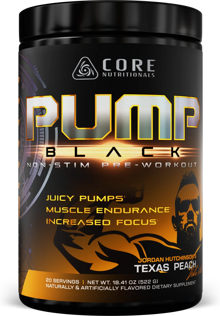
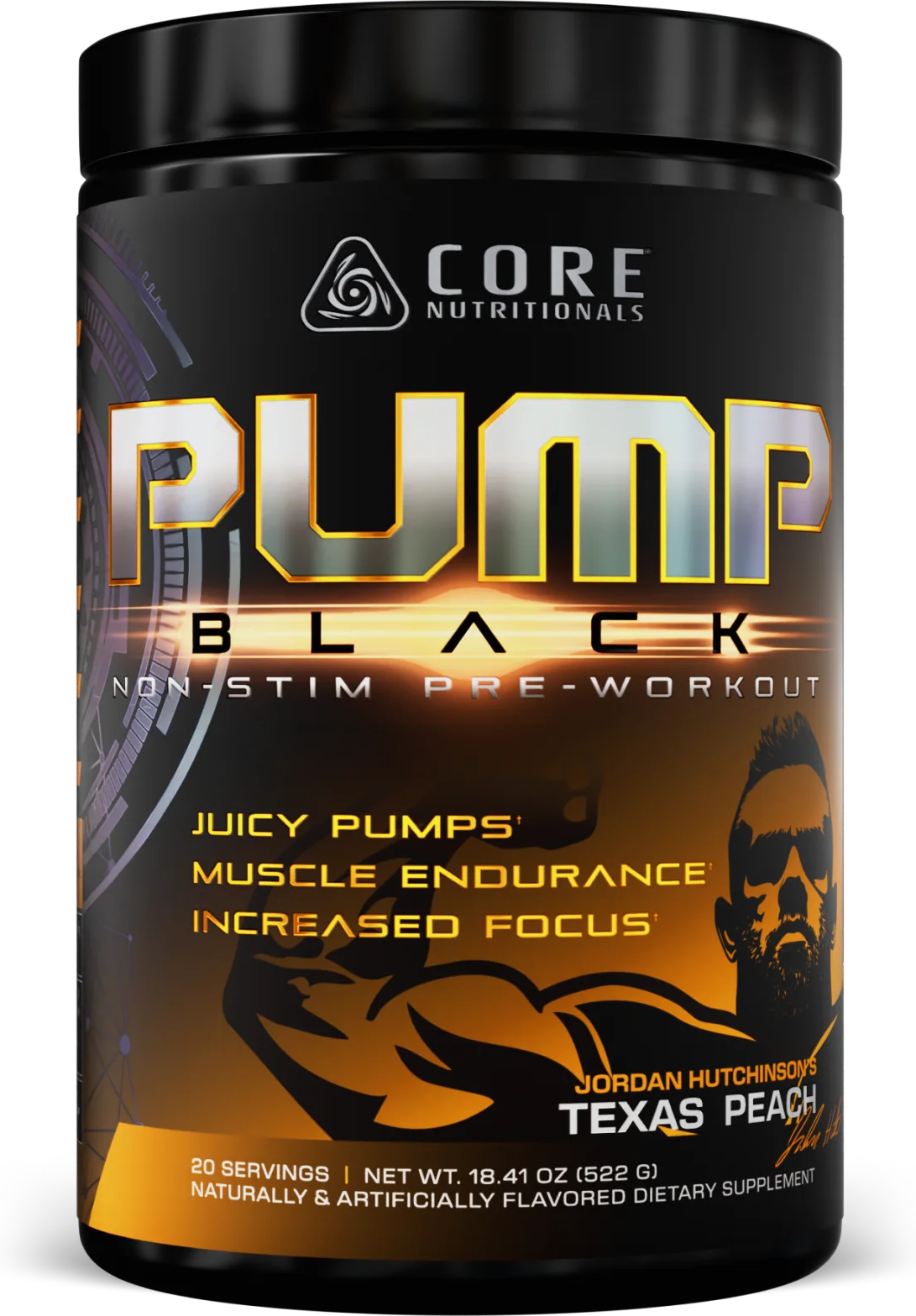
Within a performance formula like PUMP BLACK, PeptiPump should be interpreted as a hemodynamic (movement and pressure of blood through the CV system) and perfusion-support (delivery of blood, oxygen, and nutrients to tissues) ingredient rather than a primary ergogenic stimulant or buffer. Its role is to complement upstream nitric-oxide pathways (citrulline and nitrate) by improving the vascular responsiveness and tissue-level blood distribution once nitric oxide is produced. Early human and preclinical data on lentil-derived peptides suggest benefits for blood pressure regulation, endothelial health, and circulation, which provide the mechanistic rationale for enhanced exercise “pump,” muscular endurance support, and recovery signaling. However, as with many novel peptide ingredients, large independent exercise-performance trials remain limited, so the strongest scientific position is that PeptiPump contributes complementary vascular bioactivity within a multi-pathway pump system rather than acting as a standalone performance driver.
AstraGin - 50 mg
AstraGin is a standardized blend of Panax notoginseng and Astragalus membranaceus extracts developed to enhance intestinal absorption of amino acids, vitamins, and other nutrients. Mechanistic research in cell and animal models shows AstraGin can upregulate expression of key intestinal transporters (including amino-acid transport proteins and glucose transporters) and influence tight-junction integrity, suggesting improved trans-epithelial nutrient movement and gut barrier support. These transporter-modulating effects form the biological basis for its positioning as a bioavailability enhancer in sports-nutrition formulations.
Human data on AstraGin specifically are still emerging, but studies on its constituent botanicals—particularly astragalus polysaccharides and ginsenosides—demonstrate immunomodulatory, anti-inflammatory, and gut-supportive properties that may indirectly support training recovery and nutrient utilization. In applied formulation strategy, AstraGin is not intended to provide an acute perceptible effect; instead, it functions as a systems-level absorption amplifier, theoretically improving the efficiency of amino acids (like citrulline and taurine), osmolytes (betaine), and nootropics (tyrosine, citicoline) delivered in the same serving. Due to the fact that large-scale human pharmacokinetic trials remain limited, AstraGin is best interpreted as a supportive bioavailability technology with strong mechanistic plausibility and growing—but not yet definitive—clinical validation.